

In sales, ICP stands for ideal customer profile: a definition of the companies most likely to buy, succeed with your product and stay. Sales teams use the ICP to qualify leads, score fit in the CRM and decide which accounts go to senior reps, so the pipeline fills with prospects that convert and expand.
Predictable revenue comes from deliberate choices about who you sell to, why they buy, and how your entire go-to-market machine focuses on that fit.
At the executive level, whether you’re leading sales, revenue operations, or product, this isn’t a marketing exercise. It’s a systems decision. Defining and operationalizing your Ideal Customer Profile (ICP) turns chaotic growth into measurable, forecastable revenue. When people ask “what does ICP mean in business,” the short answer is ideal customer profile: a description of the companies most likely to buy, succeed, and stay.
Below is a practical, evidence-backed playbook for transforming ICP from a slide in your sales deck into an operating rhythm that produces predictable revenue.
The Real Problem: ICPs That Look Great on Paper but Fail in Practice
Most companies have an ICP. Fewer have one that actually drives revenue predictability.
The reason is that ICPs often sit in silos or are built once and forgotten. Marketing treats it as targeting data, sales sees it as a qualification checklist, and product rarely hears about it at all. The definitions split as well: the ICP meaning sales teams use is a qualification standard, while the ICP meaning business leaders need is a rule for where to spend resources.
In practice, the ICP is a shared model that marketing, sales, and product use to decide which accounts to pursue. It shows which customers produce the most consistent, scalable value, and it changes as the data changes. Treated only as an ICP business term, it rarely changes how teams work.
That’s where most organizations miss the mark. The ICP gets written once, becomes static, and loses connection to real data.
When ICPs are actively maintained and operationalized across go-to-market functions, organizations can improve win rates and shorten sales cycles by great margin.
Revenue becomes predictable once every team uses the ICP to make daily decisions, not just to fill a slide.
The Executive Case for ICP: Precision Over Volume
Every revenue leader has felt the pain of a pipeline that looks healthy but never closes. That’s a symptom of poor ICP execution.
When you target too broadly, you might fill your CRM, but you also fill it with noise. When you narrow focus too much, you risk missing scalable markets. The hard part is ICP precision: keeping enough volume in the pipeline while focusing on high-value accounts.
Here’s why this precision matters at leadership level:
- Cross-functional alignment: A living ICP keeps sales, marketing, and product working toward the same customer archetype. Every campaign, playbook, and roadmap decision flows from one shared definition of “fit.”
- Predictable forecasting: By embedding ICP-fit scoring into your CRM and qualification processes, you can forecast not just revenue, but confidence in that revenue, because your pipeline is full of prospects statistically proven to convert and expand.
- Reduced churn and CAC: When your ICP aligns with real customer success data, acquisition cost drops and lifetime value grows. Over time, this means more revenue from the same sales and marketing budget.
Readers Also Enjoy: Empower Your Marketing Effort With Sales Enablement – DevriX
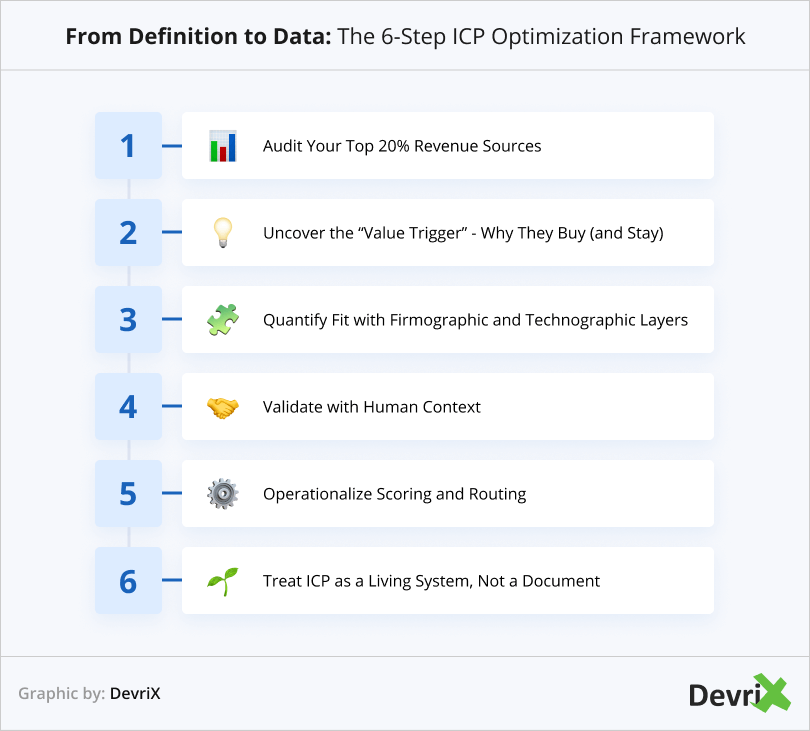
From Definition to Data: The 6-Step ICP Optimization Framework
At this stage, defining your ICP isn’t the issue. Operationalizing it is.
Here’s a 6-step ICP optimization framework designed for leadership teams ready to turn qualitative alignment into quantitative predictability.
1. Audit Your Top 20% Revenue Sources
Start with the customers who already prove your model. The most reliable way to define ICP is to work backward from them. Pull data on your top 20% by revenue, retention, or expansion rate. Identify what makes them outperform others: industry, size, growth stage, tech stack, or buying motion.
This isn’t just pattern recognition. It’s revenue attribution by fit.
Focus on measurable outcomes: retention, upsell frequency, referral activity, and ease of onboarding. Those metrics expose the true ICP signal that spreadsheets can’t.
2. Uncover the “Value Trigger”: Why They Buy (and Stay)
Beyond demographics and firmographics, look at the value trigger, the specific problem that causes your ICP to take action.
For example:
- If your customers buy because your platform consolidates siloed data, your ICP isn’t just “mid-market SaaS.” It’s companies drowning in fragmented analytics tools with urgent reporting needs.
- If your customers expand quickly, find the trigger behind it, such as faster growth, regulatory pressure or automation goals.
Once you identify that trigger, you can model it and score for it, turning behavioral cues into predictable sales signals.
3. Quantify Fit with Firmographic and Technographic Layers
Next, add quantifiable parameters. Think:
- Firmographic: industry, company size, geography, funding stage.
- Technographic: the tools they use, their data environment, their platform dependencies.
These data layers help your team separate strong prospects from weak ones without shrinking the funnel.
An effective ICP model should allow anyone in your org to evaluate a lead’s fit in under a minute. Structured ICP segmentation across these layers is what makes that speed possible.
4. Validate with Human Context
Data gets you 80% of the way. Human context gets you the rest.
Run ICP review workshops with sales, customer success, and product. Gather insights like:
- Which deals close fastest and why?
- What objections do high-fit customers not raise?
- Which customer types are hardest to retain?
Salespeople often have the qualitative nuance that data misses, like realizing that deals close faster when the buyer has internal executive sponsorship.
That’s not something your CRM will tell you, but it can be scored once discovered.
5. Operationalize Scoring and Routing
Now comes the system design.
Convert your ICP attributes into a scoring model that feeds directly into your CRM and automation tools. This is where the ICP sales meaning shifts in practice: the profile stops being a description and becomes a routing rule. Assign weighted values to signals such as industry fit, tech stack, and growth velocity.
Example fit score weighting (0 to 100 points):
| Fit signal | Weight (points) |
|---|---|
| Firmographic alignment | 30 |
| Tech compatibility | 20 |
| Value trigger present | 30 |
| Expansion potential | 20 |
Any prospect scoring 75 or more is a high-fit lead and goes straight to senior sales. Those between 50 and 74 enter nurture workflows. Prospects below 50 go to marketing automation.
This improves qualification and makes your pipeline easier to forecast.
6. Treat ICP as a Living System, Not a Document
Markets shift, products evolve, and customer needs change. Your ICP should too.
Set up a quarterly ICP review across marketing, sales, and product. Reassess top customer data, win/loss ratios, and churn patterns.
Companies that continuously refine their ICP based on performance data see measurable ROI improvements. Predictable revenue starts where static ICPs end.
Readers Also Enjoy: Sales operation vs revenue Operations: What’s the Difference? – DevriX
Turning ICP into Predictability: The RevOps Angle
When done right, your ICP becomes the core dataset that powers every GTM function:
- Marketing knows which accounts to target and tailor messaging toward.
- Sales knows which opportunities to prioritize and when to disengage.
- Product knows whose feedback should shape the roadmap.
- Finance knows how to forecast with accuracy because pipeline fit data correlates directly with close rates.
This is what RevOps was built to do: create closed-loop feedback between data, execution, and revenue.
In practice:
- Use ICP-fit data to train your lead routing and automation logic.
- Align paid and organic campaigns to ICP clusters.
- Track win-rate variance across ICP tiers.
- Feed retention and expansion data back into the ICP model quarterly.
Predictable revenue depends as much on applying the ICP consistently as on sales skill.
The ICP Flywheel: How Fit Compounds Over Time
Once ICP is operational, every cycle of customer interaction makes the next one stronger.
- Better targeting fills your funnel with high-fit leads.
- Higher conversion rates generate better customer data.
- Better data refines your ICP model.
- Refined ICP improves both retention and expansion.
This feedback loop compounds revenue precision.
Over time, the organization’s growth rate stabilizes, forecasting becomes more accurate, and your customer base becomes naturally self-filtering, made up primarily of clients that both need and thrive on your product.
That’s the foundation of predictable, profitable growth.
Readers Also Enjoy: The Hidden Dangers of Automatic WordPress Plugin Updates – DevriX
Common ICP Pitfalls (and How to Avoid Them)
Even seasoned teams fall into these traps:
- Over-generalizing: Trying to please multiple markets at once dilutes signal.
- Stagnation: Failing to update ICP data quarterly leads to poor forecasts.
- Over-automation: Relying only on scoring and forgetting human judgment.
ICP rigidity: Using ICP as a gate to innovation rather than a compass for prioritization.
Healthy ICPs evolve with feedback loops, with each iteration sharpening precision and revenue reliability.
Busy sales teams and predictable ones often work equally hard. The predictable ones focus on the right accounts.
ICP turns growth from a series of lucky wins into a repeatable model. When every function aligns on who the best customer is, your revenue motion becomes measurable, forecastable, and scalable.
Predictable revenue isn’t a mystery. It’s the inevitable outcome of a living, data-driven ICP executed with cross-functional discipline.
FAQ
Isn’t ICP just a marketing exercise?
Not when it’s done right. Marketing defines the “who,” but sales, product, and CS refine the “why” and “how.” ICP is a RevOps-level system for allocating resources toward the highest-yield customers.
How often should we update our ICP?
Quarterly. At minimum, review when product strategy, pricing, or market conditions change.
How many ICPs can we manage effectively?
One primary ICP plus up to two adjacent ones is the maximum for startups and scaling teams. Beyond that, your data quality and messaging start to fracture.
What metrics prove an ICP is working?
Track ICP-fit win rates, time-to-close, retention rate, and expansion revenue. When ICPs are precise, all four metrics improve together.
Can ICP help product teams?
Yes. Product roadmaps aligned with ICP data focus on features that generate retention and expansion, the two strongest predictors of predictable revenue.