

An ABM strategy is a B2B plan in which marketing and sales pick a list of high-value accounts and treat each one as a market of one. ABM stands for account based marketing. Instead of casting a wide net, teams align on target accounts, personalize outreach to decision-makers, and measure engagement, pipeline velocity, and revenue by account.
Broad, one-size-fits-all marketing spreads budget across accounts that will never buy. ABM concentrates effort on the high-value accounts most likely to generate revenue. That focus defines an account based marketing strategy and suits B2B teams with long sales cycles.
This guide shows how to build an ABM strategy and create an ABM content strategy, starting with the account based marketing basics before moving on to tactics.
Why You Need an ABM Strategy
Traditional marketing casts a wide net, hoping to catch the right audience. ABM, on the other hand, is laser-focused. It aligns marketing and sales teams to target specific accounts, tailoring campaigns for maximum impact. That contrast sums up ABM vs traditional marketing and shows why account based marketing suits complex B2B sales.
The table below summarizes the main differences.
| Traditional marketing | Account based marketing | |
|---|---|---|
| Audience | A wide net aimed at a broad audience | Specific high-value accounts chosen from the ICP |
| Messaging | One-size-fits-all campaigns | Content tailored to each account’s pain points and decision-makers |
| Sales and marketing | Separate plans and handoffs | One team with shared target accounts, CRM, and SLAs |
| Success measures | Reach and lead volume | Account engagement, pipeline velocity, and revenue impact |
Benefits of an ABM Strategy
If executed correctly, account-based marketing can bring numerous benefits to your business. Here are a few:
- Higher ROI. Focused efforts mean higher conversion rates and better use of resources.
- Stronger Relationships. Personalized engagement fosters trust and loyalty.
- Shorter Sales Cycles. Targeting decision-makers directly speeds up deal closures.
- Better Alignment. Marketing and sales work together towards a common goal.
Now, let’s talk about how to build an ABM strategy that works. The six steps below answer “how does account based marketing work” in practical terms.
How to Build an ABM Strategy in 6 Steps

Identify High-Value Accounts
Start by defining your Ideal Customer Profile (ICP). Look at:
- Revenue Potential. Target accounts with high revenue potential.
- Industry Fit. Focus on industries that benefit most from your solution.
- Engagement History. Prioritize accounts that have already shown interest.
Use intent data and predictive analytics tools to refine your list. Consider collaborating with your sales team to gather insights on existing customers who bring in the most revenue and have the highest potential for expansion. This is where account based lead generation starts, since the list decides which companies get your team’s time.
Additionally, leverage firmographic data, customer lifetime value, and competitive analysis to fine-tune your ideal accounts.
Align Sales and Marketing Teams
ABM only works if marketing and sales operate as one team. Both departments should:
- Agree on target accounts.
- Develop a shared content and outreach plan.
- Use the same CRM and analytics tools for tracking engagement.
Encourage regular meetings between teams to discuss account engagement and adjust strategies accordingly. Implement Service-Level Agreements (SLAs) to define responsibilities and ensure accountability between departments.
Establish clear lead handoff processes so that marketing-generated leads reach sales without delay. Clear handoffs are what turn account based marketing lead generation into pipeline instead of a list of names nobody follows up on.
Personalize Outreach for Maximum Impact
Generic messaging won’t cut it. Tailor content and communication based on:
- Pain Points. Address specific challenges faced by each account.
- Decision-Maker Preferences. Use data to determine if they prefer email, LinkedIn, or in-person meetings.
- Engagement History. Refer to past interactions for a personalized touch.
Develop relationship maps for key accounts, identifying decision-makers and influencers. Create personalized email sequences, video messages, and LinkedIn outreach strategies that address their specific business needs. These maps keep account based engagement focused on the people who actually sign off on the deal.
Consider deploying account-based gifting strategies, such as sending highly customized direct mail or curated experience offers, to deepen relationships.
Choose the Right ABM Tactics
There’s no one-size-fits-all approach. Your ABM strategy may include:
- One-to-One Marketing. Personalized campaigns for high-value accounts.
- One-to-Few Marketing. Targeted campaigns for a small group of similar accounts.
- One-to-Many Marketing. Broader campaigns with personalization at scale.
Test different tactics, such as direct mail campaigns, high-value gift experiences, and custom events to enhance engagement. Consider integrating ABM advertising campaigns that serve personalized ads to target accounts based on their interactions with your content. B2B programmatic ads can extend that reach by bidding only on impressions from companies on your target account list. Small account based marketing events, such as executive dinners or private workshops, often get more attention from these accounts than a booth at a large trade show.
Explore co-marketing opportunities and invite key prospects to participate in exclusive content collaborations.
Use Technology and Automation
ABM thrives on data and automation. Use tools like:
- CRM Platforms. HubSpot, Salesforce
- Intent Data Providers. Bombora, 6sense
- Marketing Automation Tools. Marketo, Pardot
- Account-Based Advertising. LinkedIn Ads, Demandbase
Invest in AI-powered analytics tools to gain deeper insights into account behaviors and predict future engagement. When you compare tools for ABM solution lead generation, the real test is whether the tool feeds account data back into your CRM.
Automate workflows to nurture accounts based on their stage in the buyer’s journey. Implement AI-driven chatbots and predictive lead scoring to optimize outreach and engagement efforts. Whichever account based marketing solution you choose, make sure sales can see the same engagement data that marketing does.
Track, Measure, and Optimize
Key ABM success metrics include:
- Account Engagement. Are your target accounts interacting with your content?
- Pipeline Velocity. How fast are deals progressing?
- Revenue Impact. Are your efforts translating into actual sales?
Regularly analyze data and tweak your approach for continuous improvement. Good account based marketing analytics tie each of these numbers to named accounts rather than to anonymous traffic. Use A/B testing for different content formats and outreach methods to refine your engagement strategy.
Deploy revenue attribution models to understand which ABM tactics are driving the most impact and adjust accordingly.
ABM Content Strategy: What Works
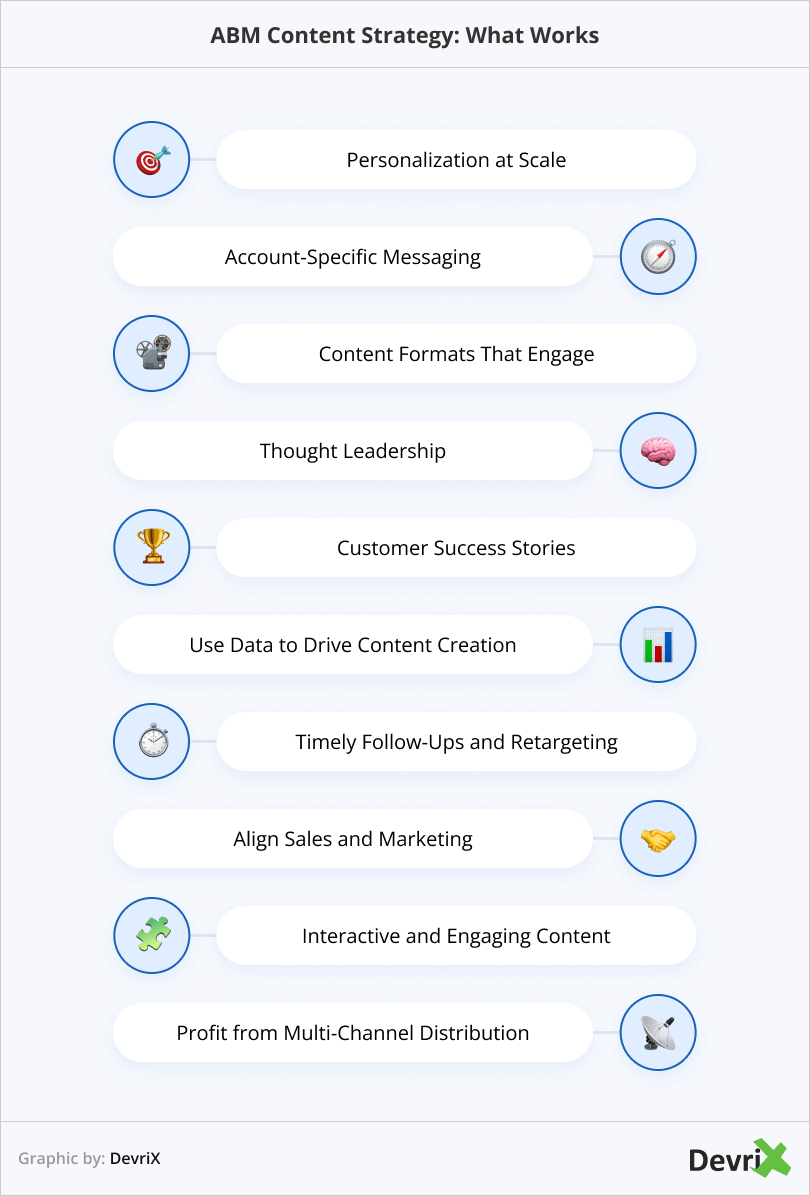
Personalization at Scale
Personalization is key in ABM, and scaling it effectively is essential. By using data-driven insights, businesses can craft content that speaks directly to the pain points and interests of specific accounts. Ask a sales rep “what does account based marketing mean?” and the day-to-day answer is usually content written for one company, not for a generic persona.
Whether it’s a personalized email or a tailored landing page, the content should resonate deeply with each account’s unique challenges and needs.
Account-Specific Messaging
Beyond just personalization, ABM thrives on relevant messaging that aligns with the target account’s business goals. Highlight how your solution can specifically address their pain points.
This requires thorough research on the company’s industry, objectives, and competitive landscape.
Content Formats That Engage
Different content formats appeal to different stages of the buyer’s journey. Use a combination of whitepapers, case studies, videos, infographics, and interactive content like quizzes to keep the audience engaged.
Be mindful of what will resonate most with the decision-makers at each target account.
Thought Leadership
Establishing your brand as a thought leader can be a powerful ABM strategy. Create content that demonstrates deep industry knowledge and insight, showcasing your expertise in solving the problems specific to your target accounts.
Blogs, webinars, and podcasts are great mediums to share this knowledge.
Customer Success Stories
Taking advantage of case studies or testimonials from customers in similar industries or with similar challenges can build credibility and trust. Highlight the success of past clients who have overcome similar pain points using your solution.
Use Data to Drive Content Creation
ABM content should be data-driven. Analytics can show what content is performing well with specific accounts and industries.
Use this data to refine your content and make sure you’re delivering the right messages at the right time.
Timely Follow-Ups and Retargeting
Content should be strategically timed to align with account buying cycles. Additionally, retargeting ads and follow-ups based on previous engagement can keep your brand top of mind. A well-timed follow-up email or targeted ad can nudge an account toward conversion. Most tools for programmatic advertising B2B teams use today support account-level targeting, which makes this kind of retargeting practical.
Align Sales and Marketing
Successful ABM requires alignment between the sales and marketing teams. Marketers must work closely with sales teams to ensure content is hitting the right points and helping to move the account down the funnel. Continuous feedback loops between sales and marketing are essential.
Interactive and Engaging Content
Incorporating interactive content such as quizzes, polls, or ROI calculators not only adds value but also encourages deeper engagement with the content.
It helps prospects engage in a more meaningful way, providing valuable data points for both the marketing and sales teams.
Profit From Multi-Channel Distribution
Your content won’t be effective if it’s not seen. Use multiple channels to reach your target audience:
- Email Campaigns. Personalized emails with tailored content.
- LinkedIn Outreach. Thought leadership posts and direct messaging.
- Webinars & Events. Exclusive events for key decision-makers.
- Retargeting Ads. Keep your brand top-of-mind with account-specific ads.
Distribute content via industry-specific online forums, exclusive Slack or LinkedIn groups, and paid partnerships with niche influencers to increase engagement.
Common ABM Mistakes to Avoid
Even the best ABM strategy can fail if you’re making common mistakes. Here are a few to watch out for:
- Lack of Internal Alignment. If sales and marketing teams aren’t fully aligned, the strategy will struggle. Ensure both teams collaborate closely, share data insights, and work towards common goals.
- Over-Reliance on Automation. While automation helps scale ABM efforts, it should never replace genuine, personalized engagement. Human touchpoints, such as direct calls, custom gifts, and handwritten notes, can significantly impact relationship-building.
- Ignoring Data Insights. Regularly analyze engagement metrics to tweak and improve your approach. If an account isn’t responding, reassess your outreach strategy and experiment with different engagement tactics.
- Targeting Too Broadly. ABM is most effective when it’s highly focused. Avoid the temptation to expand your target list too quickly. Instead, refine your ICP and prioritize the highest-value accounts.
- Neglecting Multi-Touch Engagement. A single email or ad won’t close deals. Ensure you’re engaging accounts across multiple communication channels with a mix of content, events, direct outreach, and personalized interactions.
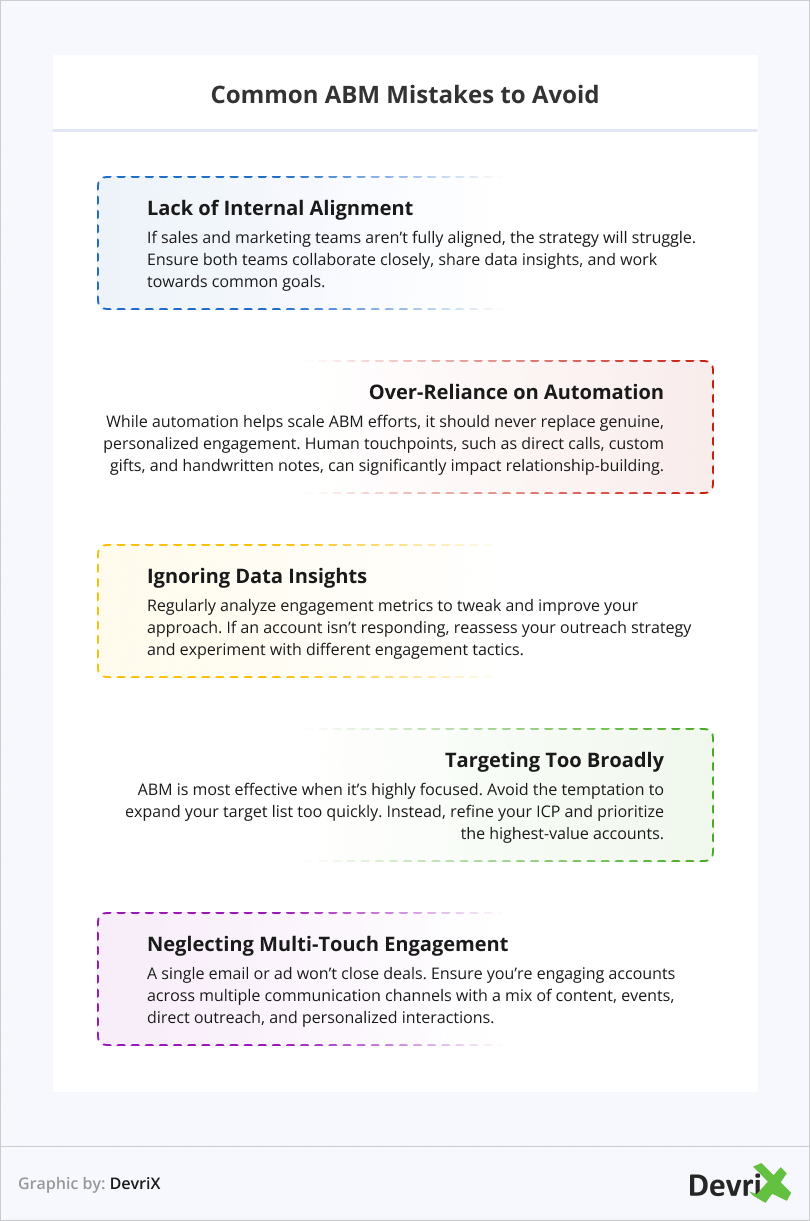
Avoid these pitfalls, and your ABM efforts will be set up for success! Read in reverse, each mistake on this list also works as one of the more useful ABM lead generation tips.
A well-executed ABM strategy can transform your marketing efforts, delivering higher ROI, stronger customer relationships, and faster sales cycles. Those results are why the account based marketing vs traditional marketing comparison tends to favor ABM in complex B2B sales.
By aligning your sales and marketing teams, using the right tools, and crafting personalized content, you can engage high-value accounts effectively.
ABM Strategy FAQ
What does ABM stand for in marketing?
ABM stands for account based marketing. When people ask “what does ABM mean,” the short answer is a B2B strategy that treats each target company as a market of one, with marketing and sales working from the same list of high-value accounts.
What is an ABM program?
An ABM program is the ongoing set of campaigns, outreach, and tracking a team runs against its target account list. It usually mixes one-to-one, one-to-few, and one-to-many tactics and runs on a shared CRM, intent data, and marketing automation.
How does ABM work?
ABM works in six steps: identify high-value accounts from your ICP, align sales and marketing, personalize outreach, choose the right tactics, set up technology and automation, and then track, measure, and optimize the results.
Why is account based marketing important?
Account based marketing puts budget and sales time on the accounts most likely to drive revenue. Done well, it brings higher ROI, stronger relationships, shorter sales cycles, and better alignment between marketing and sales.
How do you measure an ABM strategy?
Track account engagement, pipeline velocity, and revenue impact for each named account. Revenue attribution models then show which ABM tactics drive the most impact, so you can shift effort toward them.
Ready to take your ABM strategy to the next level?
Check out DevriX’s Account-Based Marketing Services to get expert support in building and executing a high-impact ABM strategy tailored to your business.